
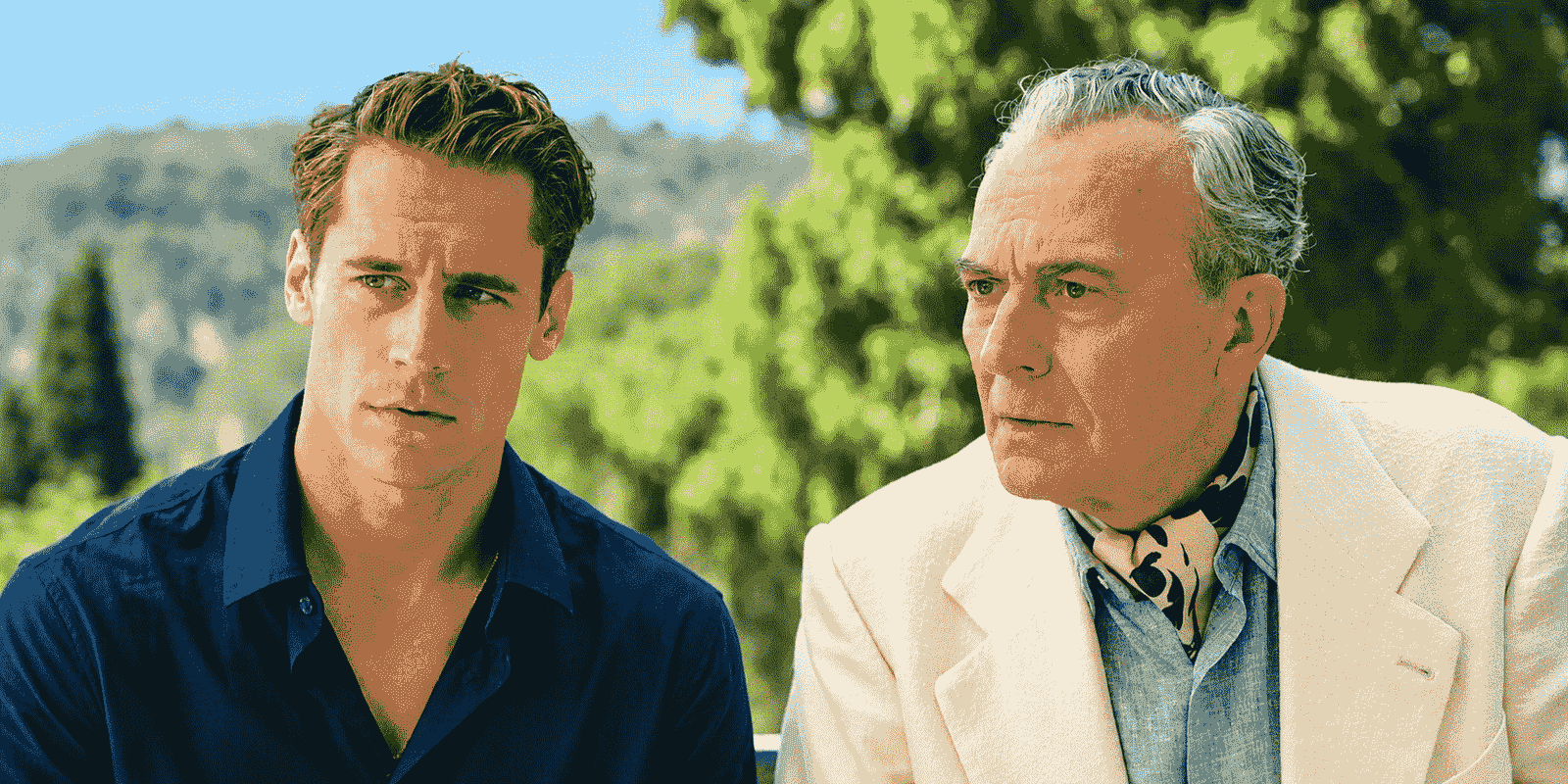
Here’s the joke sitting at the center of this whole show: an actor gets famous for playing the smartest detective in fiction, and now everyone around him genuinely expects the fiction to have rubbed off. That’s a clever premise for a locked-room mystery. Whether The Final Problem trusts that premise enough to actually run with it is the real question, and after four episodes, I came away with a more mixed answer than I expected.
Quick Facts
- Title: The Final Problem (El problema final)
- Platform: Netflix, streaming from September 25, 2026
- Genre: Period mystery, whodunit
- Episodes: 4
- Based on: Arturo Pérez-Reverte’s 2023 novel of the same name
- Director: Félix Viscarret
- Setting: A hotel on a small islet off Mallorca, 1959
- Cast: José Coronado (Basil), Martiño Rivas (Francisco Foxá), Maribel Verdú (Mrs. Ausländer), María Valverde (Adela Figueroa), Gonzalo de Castro, Pepón Nieto, Cristina Kovani, José Condessa, Daniel Holguín, Michael Stobbe
The Setup
Basil is a retired actor best known for playing Sherlock Holmes on screen, and he’s on holiday in Mallorca when a storm strands him and twelve other guests at an isolated hotel on a small islet. The radio’s down, the boats can’t leave, and an English tourist named Elisa Mander turns up dead. It looks like suicide at first. Basil isn’t convinced.
With no police reachable and no way off the island, the guests turn to the one person who feels vaguely qualified to investigate: the man who’s spent years pretending to be a detective on camera. Crime writer Francisco Foxá tags along as his Watson-of-sorts, and together they start working through a hotel full of suspects, including the hotel’s manager, Mrs. Ausländer, and a guarded guest named Adela Figueroa.
It’s a classic setup, and the show knows it. Isolated location, a storm cutting off the outside world, thirteen people who can’t leave and can’t fully trust each other. If you’ve read an Agatha Christie novel or watched any version of this formula before, you already know the shape this is going to take.
What Works
The Basil premise is genuinely clever, even when the show doesn’t push it far enough. Coronado plays Basil with a quiet awareness of his own absurdity: he knows he isn’t actually Sherlock Holmes, and so does everyone else, but the role has clearly left something behind in him anyway. Years of playing a character built entirely on observation and deduction seem to have trained his instincts in a way that’s part talent, part muscle memory from a film set. I found myself thinking about how strange it must be to have an entire hotel full of strangers trust your judgment purely because they recognize your face from a movie poster. That’s a sharp idea, and Coronado sells the quiet indignity of it well.
The setting does real work. A hotel cut off by weather in 1959 means no modern forensics, no phone lines, no easy way to fake alibis with technology. The mystery has to run entirely on conversation, observation and deduction, the old-fashioned way, and that gives the whole thing a grounded, patient feel. There’s something satisfying about a mystery that can’t be solved by anyone pulling out a cell phone.
The reveal actually has something to say. Without spoiling specifics, the eventual explanation touches on show-business exploitation, the egos of male actors, and how easily older, powerful men manipulate younger women chasing a break in the industry. There’s also a current of class tension running underneath the whole thing, the kind of transactional relationships that form when money and power sit unevenly between people trapped in the same building. I respect that the show reaches for something with actual weight instead of settling for a twist purely for its own sake.
José Coronado is doing more than the material sometimes asks of him. Whatever your issues with pacing or plotting, Coronado’s performance holds the center together. He plays Basil as a man who understands he’s an impostor wearing someone else’s authority, and there’s a melancholy underneath his confidence that I found more interesting than the actual murder plot at times.
What Didn’t Work
I’ve read a handful of other reviews of this show while putting mine together, and I want to be upfront: critics are genuinely split on this one, more than most shows I’ve covered recently. That range is worth talking through honestly, because I don’t think either extreme fully captures it.
The emotional themes get mentioned, not felt. The show’s best ideas, the exploitation, the manipulation, the class resentment, mostly arrive as a couple of expository lines packed into the final reveal rather than something the story builds toward across the runtime. I wanted those themes woven through the earlier episodes, not saved for a rushed explanation at the end. As it stands, you understand the tragedy intellectually without feeling its full weight.
The location is gorgeous and strangely underused. A hotel on a small Mediterranean islet in 1959 should feel alive with atmosphere, texture, salt air, faded elegance. Instead, several scenes feel oddly flat, almost like they could have been shot anywhere. One critic went so far as to say it looked like it could have been filmed entirely on a green screen, and while I wouldn’t go that far myself, I understand the frustration. A story this reliant on its setting needed the setting to do more heavy lifting than it does here.
Some of the cast plays it too composed. A few of the supporting guests come across less like frightened people trapped with a possible killer and more like chess pieces waiting their turn to be questioned. Cristina Kovani’s character shows flashes of real mischief early on, and I wanted more performances willing to break from the show’s overall stateliness the way she occasionally does.
The mystery stays a step ahead of you, but that’s not quite the same as being satisfying. This is my honest criticism, and it’s the one I keep coming back to. The show is competent at withholding information and keeping you guessing, but a genuinely great whodunit makes you want to rewatch earlier scenes once you know the answer, because every clue was quietly sitting there the whole time. I didn’t feel that pull here. The reveal explains itself well enough, but it doesn’t reorganize how you see the rest of the story, which is usually the real payoff of this genre.
It plays it safe with its most interesting question. The show raises a genuinely compelling idea: what if Basil’s borrowed authority, the fact that everyone defers to him simply because of a role he once played, could actually make him dangerous rather than just useful? That’s a fascinating tension for a mystery to sit inside. The show gestures at it and then largely returns to the mechanics of solving the case instead of following that thread all the way through.
My Own Theory Going In (and Coming Out)
Before I watched, I genuinely wondered whether the show was building toward making Basil the culprit himself, using the murders as a strange, twisted way of recapturing his old glory as a “great detective.” That would have been a bold, almost self-aware twist: an actor committing crimes just to have something worthy of his old performance to solve. The show doesn’t go there, and I understand why, it would have undercut the more grounded, human explanation the story actually lands on. But I think that road not taken says something about where this show’s ambitions stop. It’s happy to gesture at a darker, stranger version of itself without actually becoming it.
Should You Watch It?
If you enjoy a handsome, old-fashioned whodunit and don’t need every clue to reward a rewatch, this is a comfortable four episodes. Coronado is good company throughout, the period setting has real charm even when underused, and the reveal has more on its mind than most streaming mysteries bother with. If you want a mystery that actively rewards your attention scene by scene, or a location that feels as alive as the premise promises, you’ll likely leave a little hungry, in the same way a few other critics clearly did.
My rating: ★★★ (3 out of 5)
It’s a decent, well-acted whodunit that never fully commits to its own best ideas. Worth a watch on a quiet weekend, not a show I expect to think about for long after the credits roll.
Your turn: Did the reveal land for you, or did you see it coming a mile away? Let me know in the comments, and catch The Final Problem on Netflix now.