
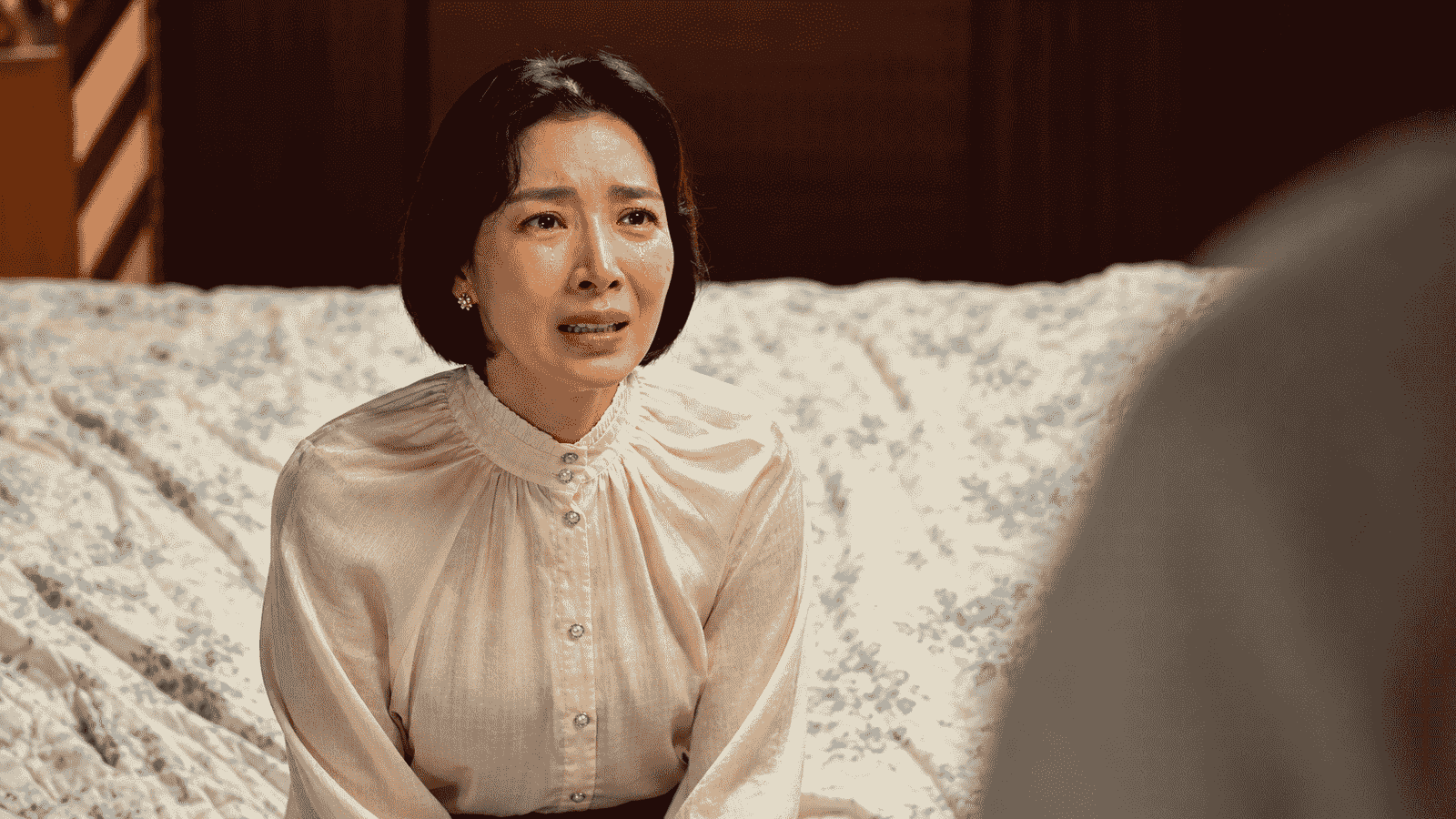
I keep coming back to one small detail from this episode: nobody in it actually lies badly. Ji-hye doesn’t lie badly. Pi-o doesn’t lie badly. Even Jeong-yo, who might be hiding the biggest secret of all, doesn’t lie badly. Everyone here is good at it, practiced at it, and that’s what makes the whole hour feel less like a drama plot twist and more like watching a family that has quietly agreed, without ever saying so out loud, to keep hurting each other gently instead of honestly.
That’s the note I want to build this piece around, instead of just walking through the episode beat by beat the way most recaps do.
The Photograph Nobody Wanted to See
Detective Martin doesn’t storm into the story. He just sends a photo. That’s it. One image of Ji-hye talking to a security guard, years ago, right before the exact competition where Jeong-yo got kidnapped on his way to compete.
I find that quiet delivery more effective than a dramatic confrontation would’ve been. A phone buzzing with a single attachment is such an ordinary, modern way for a life to fall apart. Pi-o doesn’t get a villain monologue moment. He gets a JPEG.
He tries, at first, to talk himself out of what he’s looking at. That instinct feels painfully real to me. Most people, shown evidence against someone they love, spend the first few minutes negotiating with the picture instead of accepting it.
The Confession That Fixes Nothing
By that night, Pi-o has his mother cornered, drunk, off guard. And she confesses fast. Almost too fast. I don’t think that’s sloppy writing. I think it’s the point.
Ji-hye isn’t someone who needs to be broken down over hours of interrogation. She’s someone who has been waiting, quietly, for years, to finally be caught, the way people who’ve buried something heavy sometimes feel relief the moment the shovel hits it. She admits she hired the kidnapper. She admits it was about making sure Pi-o would win. And then, almost in the same breath, she tells her son that revealing any of this now would only ruin his future.
That’s the part that unsettled me most. She isn’t defending her past self. She’s negotiating for her future self. When Pi-o pushes for a real apology to Jeong-yo, she threatens to end her life instead. A confession, in her hands, becomes just another tool for control.
I don’t think the show wants us to hate her simply. I think it wants us to recognize her, the parent who has convinced themselves that protecting their child’s opportunities is the same thing as protecting their child.
A Debt Dressed Up as a Favor
The next scene that stuck with me wasn’t the confrontation. It was the quieter one: Pi-o going to Jeong-yo, not to talk about the kidnapping at all, but to admit something smaller. That he only won the Harmonie Competition, all those years ago, because Jeong-yo gave him his sheet music.
Jeong-yo’s response tells you everything about how he actually experiences their friendship. He’s not moved that Pi-o admitted it privately. He’s frustrated that Pi-o will only ever say it privately. There’s a version of Pi-o who could have said this in public, where it would’ve cost him something real. Instead, he says it in a kitchen, to one person, where it costs him nothing but a moment of discomfort.
Then Jeong-yo does something that reframes the entire episode for me: he asks Pi-o to be the soloist for his new concerto, and frames it as Pi-o’s chance to “make up” for the sheet music. On paper, that’s generous. In practice, it’s leverage dressed in kindness. He even says he won’t hold the concerto at all if Pi-o refuses.
I keep turning this over in my head. Is Jeong-yo doing this because he genuinely wants closure with his friend? Or because some part of him, consciously or not, wants Pi-o to feel exactly the kind of trapped, obligated pressure that Jeong-yo himself felt for years? I don’t think the show has answered that yet, and I don’t think it wants to, not this early.
Two Ways of Touching the Same Piano
The one thread I actually loved without any reservations this episode: the way Jeong-yo tries to teach Pi-o to stop playing the correct notes and start “feeling the rhythm with his soul.”
It sounds like a cliché line if you write it out flat like that. But watching Pi-o struggle to actually apply it, watching him get visibly irritated because technical correctness has been his entire identity since childhood, made the metaphor land in a way I didn’t expect. Pi-o has spent his whole life being the best at doing things the right way. Jeong-yo has spent his whole life surviving by feeling things the honest way. Of course they can’t understand each other’s instructions. They’ve built two completely different relationships with the same instrument, and by extension, two completely different relationships with truth itself.
That’s the smartest piece of writing in the whole episode, and it’s buried in what looks like a simple music-practice scene.
An Old Man’s Casual Cruelty
Meanwhile, Kang Seung-woon decides he wants to step down and hand his position to Jeong-yo. Ji-hye is furious. That part is expected.
What struck me harder was one throwaway line from Seung-woon: he says he sees the same hunger for music in Pi-o that he has in himself, but adds that Pi-o simply doesn’t have the same talent. He says it plainly, almost gently, the way people say devastating things when they’ve stopped noticing how devastating they are.
I don’t think Seung-woon believes he’s being cruel. That’s what makes it worse. An entire family built around music seems to run on this same current: people deciding, out loud, who deserves love and legacy, and who merely gets to work hard for scraps of it.
Then, mid-rehearsal, he starts feeling real pain in his ribs. The show is clearly setting up his decline. I’d bet his health becomes the actual mechanism that forces Jeong-yo into the spotlight, whether Jeong-yo wants it or not.
The Question Ji-hye Accidentally Plants
Here’s the detail I think most viewers will underweight this week: Ji-hye’s throwaway suspicion that Jeong-yo is faking his amnesia.
Pi-o brushes it off in the moment, finally telling his mother, for the first time all season, to leave Jeong-yo alone and stop following him. It’s a genuinely satisfying beat, watching him draw a line with her. But the show doesn’t let that moment feel clean. It ends instead with Pi-o walking, alone, to the concert hall where he and Jeong-yo used to spend time as kids, reading the same inscription he once saw Jeong-yo staring at.
That’s not a coincidence of staging. That’s the show quietly telling you Pi-o now believes his mother might be right, even as he defended Jeong-yo to her face minutes earlier.
Why I Think the Guns Matter More Than the Confession
Here’s where I want to add something the episode itself doesn’t spell out, but that’s been bothering me since the confession scene.
Ji-hye admits to hiring a kidnapper. Fine. But a kidnapping meant only to delay a rival from reaching a competition doesn’t need armed men. A bribed official, a fake emergency, a locked door somewhere inconvenient, any of that would have done the job with far less risk. Guns imply someone planned for the possibility of real violence, not just inconvenience.
That gap, between what Ji-hye’s stated motive requires and what the actual kidnapping involved, is the loudest unanswered question in the show right now. My honest theory is that Ji-hye hired the kidnapper, but someone else escalated the job once it was already in motion. And given how deliberately the show has been building Seung-woon’s philosophy of music around the exact same language Jeong-yo uses, “feel it, don’t just play it correctly”, I wouldn’t be shocked if Jeong-yo turns out to share blood with this family, not just a stage and a rivalry. That would turn Ji-hye’s crime from a single act of jealousy into something with much older, uglier roots she isn’t the true architect of.
I could be completely wrong. But the show has been dropping this kind of quiet parallel language too consistently for it to be nothing.
Where This Leaves Everyone
Nobody in this episode gets punished. Nobody gets rewarded either. Ji-hye’s confession changes nothing about Jeong-yo’s actual situation, his memory, his safety, his standing at the agency. Pi-o’s small admission to Jeong-yo changes nothing about the much bigger one he’s still hiding. Even Seung-woon’s decision to step aside is framed less as generosity and more as an old man quietly deciding, once again, who gets to matter.
What the episode is really about, I think, is how confession, in this family, functions less like honesty and more like currency. Everyone spends just enough truth to relieve their own guilt, and never quite enough to actually repair anything.
My rating: ★★★½ (3.5 out of 5). Quietly one of the better episodes for what it refuses to resolve.
Your turn: do you think Jeong-yo already knows everything, and is simply choosing, for his own reasons, not to say so yet? Tell me what you think in the comments.