
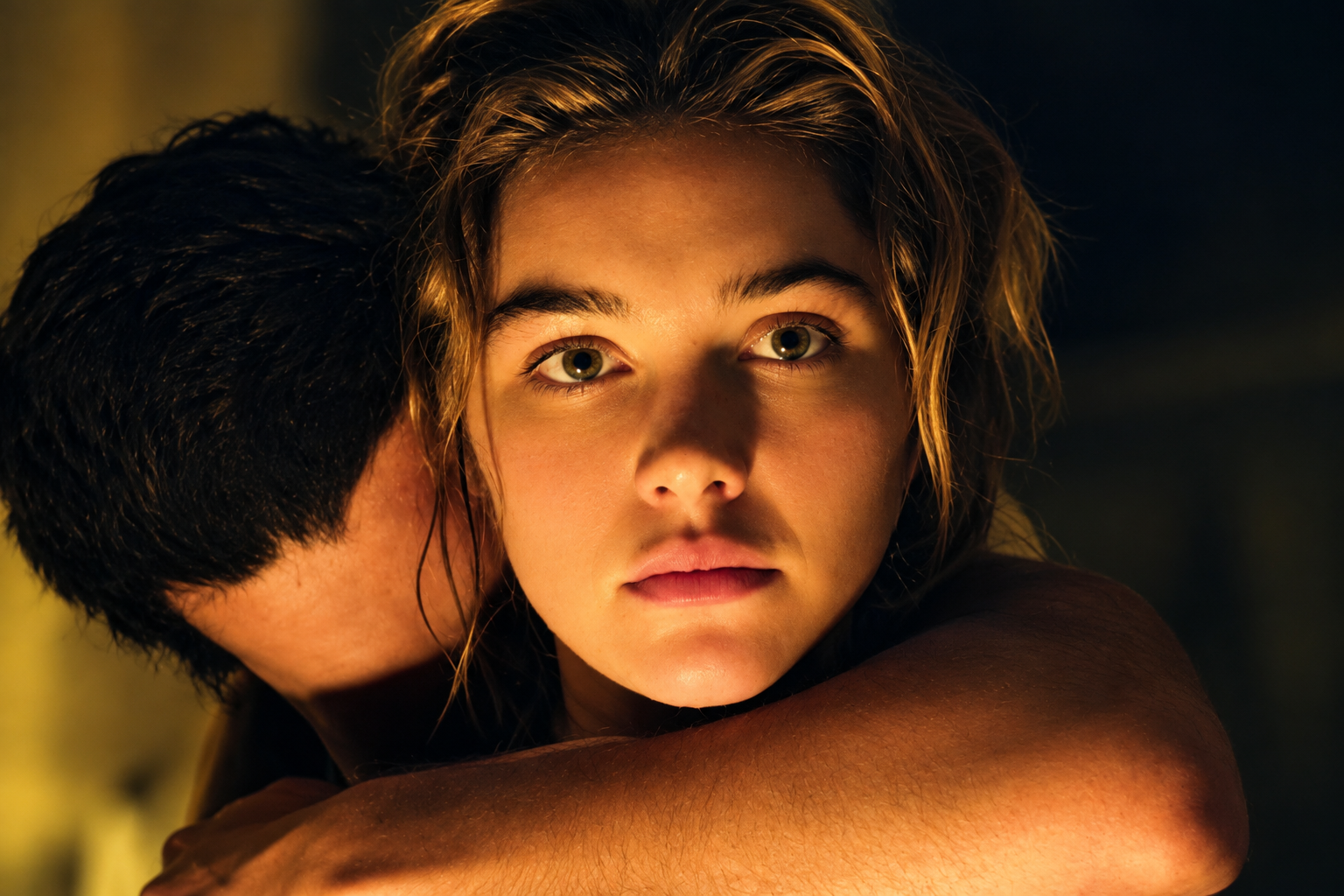
Some adaptations try to make a villain likable. East of Eden does something harder. It makes Cathy Ames understandable without ever asking you to forgive her.
That’s the tightrope this seven-episode Netflix series walks for its entire runtime, and it’s walked almost entirely on the shoulders of one performance. Florence Pugh plays Cathy as a woman who has turned survival into a skill so refined it looks like evil from the outside. Whether the rest of the show around her earns that same level of craft is the real question, and the honest answer is: not quite, but it comes close enough to matter.
Quick Facts
- Title: East of Eden
- Platform: Netflix, all seven episodes released October 1, 2026
- Genre: Period family drama
- Based on: John Steinbeck’s 1952 novel of the same name
- Creator and writer: Zoe Kazan, granddaughter of Elia Kazan, who directed the 1955 film version
- Directors: Garth Davis (Episodes 1-4), Laure de Clermont-Tonnerre (Episodes 5-7)
- Cast: Florence Pugh (Cathy Ames), Christopher Abbott (Adam Trask), Mike Faist (Charles Trask), Joseph Zada (Cal Trask), Joe Anders (Aron Trask), Martha Plimpton (Faye), Ciarán Hinds (Samuel Hamilton), Hoon Lee (Lee), Tracy Letts (Cyrus Trask)
- Setting: California’s Salinas Valley, from the years after the Civil War into the early twentieth century
What It’s About
Two brothers, Adam and Charles Trask, find a battered, bleeding woman on their doorstep. They take her in. She tells them to call her Cathy. Charles distrusts her instantly. Adam falls for her anyway, and that single choice sets off a family saga that stretches across generations, inheritance, rivalry, and the question of whether any of us are free to become something other than what we were made from.
If that sounds like it’s borrowing from Genesis, that’s because it is, deliberately and openly. Steinbeck built his novel as a retelling of Cain and Abel, and the show keeps that structure intact: two brothers competing for a father’s love, a woman who some readers have called a stand-in for the serpent in the garden, and sons who inherit their parents’ war with themselves whether they want to or not.
Unlike the famous 1955 film, which only covered the back third of the book and made James Dean a star doing it, this version has seven hours to work with, which means it can actually attempt the whole sprawling story Steinbeck wrote, not just its most dramatic final stretch.
What Works
Florence Pugh is the reason to watch this show, and I don’t say that as a small compliment. Cathy Ames has spent more than seventy years as one of literature’s most argued-over characters: is she Steinbeck’s most complex creation, or his cruelest piece of writing about women? Kazan’s version doesn’t settle that argument so much as refuse to let you settle it either. Cathy still burns down a house, still kills, still walks away from her own children. The show does not soften any of that. What it does is show you the machinery underneath: a woman raised to distrust everyone, who has turned that distrust into a survival skill so complete it reads as monstrous from any angle except her own. Pugh plays her as watchful rather than theatrical, someone constantly calculating who in the room can be used and how, and when her composure cracks, usually with a glass of wine or champagne in hand, it lands with the same dread as a horror movie reveal. You know something is coming. You just don’t know how bad.
The show commits to its theme instead of just gesturing at it. Steinbeck’s novel hangs on a single Hebrew word, “timshel,” which the book translates, somewhat loosely, as “thou mayest.” The idea is simple and enormous at once: we are not doomed to repeat our parents, nor permanently defined by what has been done to us. We get to choose, for better or worse, and that freedom is both a gift and a curse. It would be easy for a TV adaptation to let that idea sit quietly in the background. This one keeps returning to it, through Adam’s relationship with his own sons, through Cal’s fight against the parts of himself he’s afraid he inherited from his mother, and through Cathy’s own refusal to ask anyone for forgiveness. She isn’t seeking pity. She’s seeking the right to keep choosing for herself, which is a stranger and more unsettling idea than straightforward villainy.
Hoon Lee and Ciarán Hinds quietly hold the show together. As Lee, the Trask family’s loyal servant, and Samuel Hamilton, the Trasks’ neighbor, these two actors model a version of masculinity that’s warm, decent, and emotionally available, which puts them in direct contrast to almost every other man Cathy has ever known. Their scenes don’t carry the series’ biggest dramatic weight, but they give it its moral center, and more than one critic singled Lee out as the show’s emotional balance against Cathy’s chaos.
Joseph Zada gives the back half of the season its pulse. As Cal, the son who spends his life terrified he’s inherited his mother’s darkness, Zada plays a young man actively fighting himself in nearly every scene, not always winning, which is exactly the point. His arc becomes the show’s clearest answer to its own central question: inheritance isn’t destiny, but it isn’t nothing either.
It looks and sounds like the kind of prestige television Netflix rarely commits to anymore. The Salinas Valley setting carries real scale, and several critics praised the production for refusing to over-light its darker material, letting Cathy’s story play out in claustrophobic, shadowed interiors instead of glossy period polish. One reviewer called the show “delightfully monstrous” specifically because of that visual choice, and I think that’s exactly right. The show looks like it understands its own subject matter.
What Didn’t Work
I want to be upfront about this, because a review that only praises Pugh isn’t telling you the whole truth about what it’s like to watch all seven hours.
The show is so interested in Cathy that everyone else gets thinner. This is the most consistent complaint across critics, and after watching the full run, I understand why. Adam, the show’s nominal moral center, mostly functions as a symbol of innate goodness rather than a fully formed person. He rouses himself occasionally to work through his feelings about his own father and brother, usually through some half-baked business scheme or a parenting decision, but he rarely feels like someone making active choices the way Cathy does. For a show built around the idea that everyone gets to choose who they become, it’s a strange gap that the character meant to represent “goodness” barely seems to choose anything at all.
Pugh’s reduced presence in the back half genuinely hurts the show. Cathy appears less frequently as the series moves into its second half, and the energy drops noticeably whenever she’s off screen for too long. That’s not a knock on the actors filling the space. It’s simply a sign of how much weight one performance was carrying, and how little the show built up around her to compensate.
Large pieces of Steinbeck’s novel get cut, and the Hamilton family is the biggest casualty. In the book, Samuel Hamilton’s own large family and their struggles run parallel to the Trask story, giving the novel’s world room to breathe beyond one household’s drama. Almost all of that has been excised here. Hinds gives Samuel real warmth in the scenes he does get, but his own family’s story barely exists, which makes the Salinas Valley feel smaller and less populated than Steinbeck intended.
Some critics found the adaptation stiff where it should have been alive. Not every reviewer was as won over as I was by the show’s restraint. One major outlet described it as subdued, arguing that despite Pugh’s clear command of the role, too many scenes around her feel like they’re going through the motions of a prestige adaptation rather than genuinely inhabiting one, calling parts of it “paint-by-numbers.” I don’t think that’s entirely fair to the whole season, but I understand the complaint, especially in stretches where the show cuts between Cathy’s sharp, focused scenes and Adam’s more diffuse, wandering ones. The tonal gap between the show’s best scenes and its merely adequate ones is real, and it’s wide enough to notice.
Seven hours still isn’t enough for this novel, and the show knows it. Steinbeck’s book is genuinely massive in scope, and even with more than twice the runtime of the 1955 film, this adaptation has to make hard cuts to larger philosophical and moral threads that the novel spends chapters unpacking. The show gestures at these ideas rather than fully earning them in a few places, which is probably unavoidable given the material, but it’s a real cost nonetheless.
My Own Theory on Why This Version Works When It Does
Here’s where I want to push past just summarizing other critics and give you my actual read on what makes this adaptation click in its strongest moments.
I think the smartest choice Kazan made wasn’t really about Cathy at all. It was about resisting the urge to give her a clean redemption arc or a clear villain turn. Most prestige adaptations of difficult literary women end up picking a lane: either “secretly sympathetic all along” or “irredeemable, and the show knows it.” This version refuses both exits. Cathy’s cruelty is real and specific. So is the context that shaped her. The show never asks you to pick a side, and that, more than any single performance choice, is what makes her feel genuinely dangerous rather than just a prestige-TV antagonist with a backstory. A woman you can fully explain stops being frightening. A woman you can almost explain, but not quite, stays unsettling for the entire runtime. That’s the trick this show pulls off, when it’s working at its best.
The flip side of that same choice is probably why Adam feels so underwritten. If the show had spent equal energy explaining him the way it explains Cathy, it might have balanced the cast better, but it also might have flattened the central tension the whole story depends on: one person choosing endlessly, visibly, dangerously, and another person simply being good, almost by default, with far less drama attached to the choosing. I don’t think that’s a flaw exactly. I think it’s a trade-off, and I think the show mostly makes the right one, even though Adam pays the price for it.
Should You Watch It?
If you want a performance you’ll still be thinking about days later, Pugh alone makes this worth the seven hours. If you’re coming in as a devoted Steinbeck reader expecting every thread of the novel honored equally, you’ll likely notice what’s missing more than I did. And if you want a show that gives every character the same weight as its lead, this isn’t built that way, deliberately.
My rating: ★★★★ (4 out of 5)
It’s an ambitious, occasionally uneven adaptation that finds real greatness whenever Pugh is on screen, and settles for competent whenever she isn’t.
Your turn: Do you think Cathy Ames deserves the sympathy this adaptation gives her, or does it go too far trying to explain a character Steinbeck wrote as something closer to pure evil? Let me know in the comments, and stream East of Eden on Netflix now.